Published July 6, 2026 · Last updated August 29, 2026
You’ve found what you want on Taobao or from a Chinese supplier. Now comes the question every importer eventually faces: how do I actually get this to Singapore?
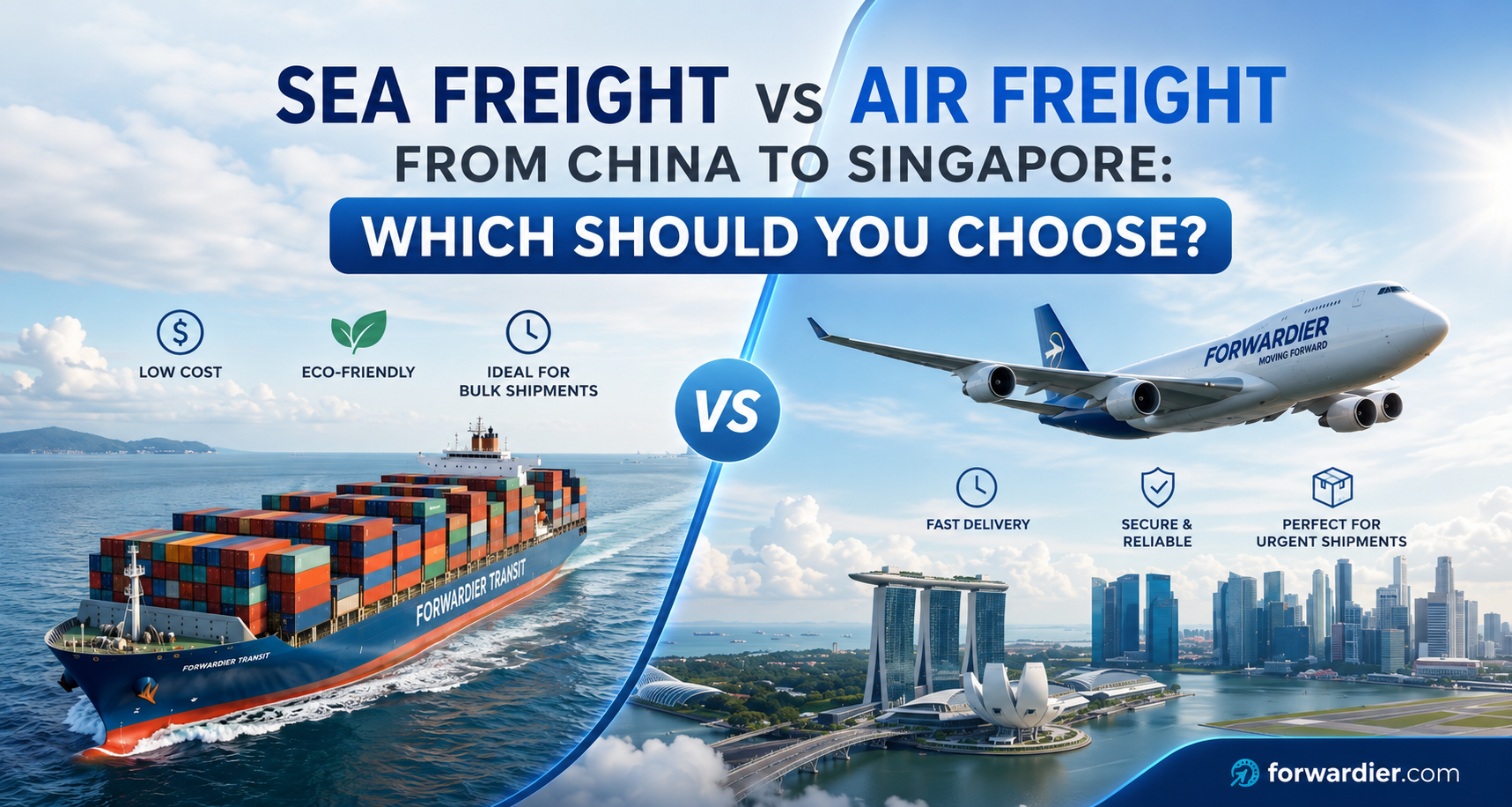
Sea freight and air freight are the two main options for shipping goods from China to Singapore. Both will get your goods here. But they differ significantly in cost, speed, and what types of cargo they suit best — and picking the wrong one can mean either overpaying or waiting far longer than you need to.
This guide breaks down exactly how each option works, what it costs, and how to decide which is right for your shipment.
Choose sea freight if your cargo is heavy, bulky, or non-urgent. Choose air freight if you need delivery within a week or your items are light and time-sensitive.
The rest of this guide explains the reasoning in detail — including real pricing, how costs are calculated, and specific scenarios where one clearly beats the other.
Sea freight moves your cargo by container ship from China to Singapore. Your goods are loaded into a container — either sharing space with other shipments (LCL, or Less than Container Load) or occupying an entire container on their own (FCL, or Full Container Load). For most individual buyers and small businesses, LCL sea freight is the standard choice.
Sea freight from China to Singapore is priced in one of two ways, depending on the size and weight of your cargo:
Volumetric weight is calculated to account for cargo that takes up significant space but doesn’t weigh much — a large, light item like a folded mattress or a hollow piece of furniture would otherwise cost almost nothing to ship relative to the space it occupies. When volumetric weight is higher than actual weight, the volumetric figure is used for pricing.
Send Forwardier your item dimensions and actual weight on WhatsApp. We’ll calculate your chargeable weight and give you a firm quote within minutes — before you commit to anything.
From our China warehouse to your Singapore door, sea freight typically takes 2 to 3 weeks. This includes warehouse processing time in China, port loading, the sea transit itself (roughly 3–5 days between China and Singapore), customs clearance at Singapore port, and last-mile delivery.
Air freight moves your cargo by plane, either on dedicated cargo flights or in the hold of commercial passenger flights. It’s significantly faster than sea freight and the right choice when speed is more important than cost — or when your cargo is light enough that the higher per-kg rate is still reasonable.
Air freight is priced from $15 SGD for first 1kg, using chargeable weight — actual weight or volumetric weight, whichever is greater. Subsequent kg will be $7 SGD.
The air freight volumetric formula is: Length (cm) × Width (cm) × Height (cm) ÷ 6,000. This formula is used universally across the air cargo industry.
For example: a package measuring 50cm × 40cm × 30cm has a volumetric weight of 50 × 40 × 30 ÷ 6,000 = 10kg. If the actual weight is 6kg, you’d be charged for 10kg.
Aircraft cargo space is at a premium — more so than sea containers. The 6,000 divisor reflects the higher value of space on a plane. This is why large but light items (pillows, clothing in bulk, hollow décor pieces) can be expensive to air freight despite their low actual weight. Sea freight uses a different volumetric calculation that generally results in lower chargeable weights for the same cargo.
From our China warehouse to your Singapore door, air freight typically takes 3 to 6 working days. This includes warehouse processing in China, cargo booking, flight transit (usually 1–2 days), Singapore customs clearance, and local delivery.
Sea Freight | Air Freight | |
Cost per kg | From $8 SGD for first 2kg | From $15 SGD for first 1kg |
Volume pricing | From $30 for first 0.10 CBM | Volumetric weight (L×W×H÷6,000) |
Transit time | 2–3 weeks | 3–6 working days |
Best for | Bulky, heavy, high-volume cargo | Light, urgent, high-value goods |
Minimum order | None — from 1kg | None — from 1kg |
Container options | LCL (shared) or FCL (full) | Consolidated air cargo |
Import permit | From $35 SGD | From $55 SGD |
Ideal for Taobao? | Large hauls, furniture, tiles, appliances | Small urgent orders, samples, high-value items |
Rather than thinking about sea vs. air as a binary choice, think about it in terms of three factors: the weight and size of your cargo, your timeline, and your budget.
This is often the most decisive factor. Run this quick check:
How urgently do you need the goods?
For high-value items (luxury goods, precision electronics, bespoke pieces), the air freight premium may be worth paying purely to reduce handling time and transit risk. Goods that spend 3 weeks in a sea container go through significantly more physical handling than those that spend 5 days in air cargo. For standard consumer goods and building materials where cost is the priority, sea freight almost always wins.
Choose Sea Freight when… | Choose Air Freight when… |
Your cargo is heavy or bulky | Your cargo is light (under 5kg) |
You can wait 2–3 weeks | You need delivery within a week |
Cost matters more than speed | Speed matters more than cost |
You’re ordering a large Taobao haul | You’re ordering samples to evaluate first |
You’re replenishing stock regularly | Your goods are high-value or fragile |
Your items are not time-sensitive | You missed a sea freight deadline |
Total weight: 120kg. Dimensions: multiple cartons averaging 60cm × 40cm × 40cm each. Timeline: 3 weeks is acceptable. Budget: cost-sensitive.
Recommendation: sea freight
At 120kg and with a flexible timeline, sea freight at $8/kg = approximately $90 SGD landed. Air freight at $15/kg = approximately $700 SGD. Sea freight saves around $600 SGD on this single shipment — a meaningful difference for a small business.
Total weight: 3kg. Dimensions: 5cm × 5cm × 5cm each (flat tiles). Timeline: need to evaluate before placing a full order. Budget: cost is secondary to making the right decision.
Recommendation: air freight
This is exactly the scenario where air freight earns its premium. Getting the samples to Singapore in 5 days means you can evaluate the tile quality and confirm your choice before placing a full sea freight order of 5 CBM. The air freight cost is small relative to the cost of ordering 5 CBM of the wrong tile.
Total weight: 200kg. Volume: 2 CBM. Timeline: renovation starts in 4 weeks. Budget: would prefer sea freight savings.
Recommendation: sea freight — but check sizes first
At 2 CBM and 200kg, sea freight is clearly the right economic choice. However, as our vanity set case study shows, large items like bathroom fittings can be rejected by Taobao’s direct shipping system due to size restrictions. Always confirm with a freight forwarder before ordering that your items will be accepted — and use the forwarder’s China warehouse address, not Taobao direct shipping, for oversized goods.
Total weight: 30kg. Product type: electronics accessories. Timeline: need stock in Singapore within 5 days. Budget: willing to pay premium for speed.
Recommendation: air freight
When revenue from a sales campaign depends on having stock available, the air freight premium is justified by the opportunity cost of being out of stock. At 30kg, the price difference between sea and air is approximately $140 SGD — a negligible figure compared to potential sales lost from a stockout during 11.11.
Yes — and this is often the smartest approach for renovation and interior design purchases.
The most common combination is: air freight your samples first, evaluate them in person, then place a full sea freight order once you’ve confirmed the quality, colour, and finish are right.
This is exactly what Forwardier coordinated for a Bidadari homeowner importing marble floor tiles from Foshan. The air-freighted tile samples arrived within a week, the client confirmed their selection, and the full 5 CBM sea freight shipment followed — arriving in perfect condition and approximately 20% cheaper than equivalent Singapore-sourced tiles.
Using both services together costs more than sea freight alone, but it eliminates the risk of receiving an expensive shipment you’re not happy with.
Yes, with the right packaging. Sea freight involves more handling than air freight — loading into containers, port handling, unloading — so fragile items like glass, ceramics, and marble need robust packaging. Forwardier recommends wooden crating for high-value or particularly fragile goods. We inspect all incoming items at our China warehouse and flag packaging concerns before shipment.
Customs delays most commonly occur when goods require an import permit that hasn’t been arranged, when documentation is incomplete, or when goods are flagged for random inspection. A good freight forwarder prepares documentation correctly upfront to minimise this risk. When delays do occur, Forwardier handles the communication with customs authorities on your behalf.
Not in the same physical shipment — sea and air freight use separate logistics chains. However, you can split your order: send some items by air and the rest by sea. This is useful when part of your order is urgent and the rest isn’t. Tell us what you need when you request your quote and we’ll advise the best split.
Allow at least 3 weeks from when your goods are ready at the supplier to delivery in Singapore. If your goods need to be ordered and manufactured first, factor in production time on top of this. For time-sensitive situations, let us know your deadline when you enquire and we’ll advise whether sea freight is still viable or whether air freight is safer.
Forwardier coordinates pickup from suppliers across mainland China. Foshan, Guangzhou, Shenzhen, Shanghai, Yiwu, and Hangzhou are among the most common origin points for Singapore importers. If your supplier is in a less common location, let us know and we’ll advise on routing and lead time.
There are many freight forwarders offering Taobao shipping to Singapore. Here’s what makes Forwardier different:
Send Forwardier your Taobao cart link, item list, or supplier details on WhatsApp. We’ll recommend the right shipping method for your specific cargo, give you a transparent cost breakdown for both options, and flag anything to watch out for before you order.
Most quotes are turned around within minutes during business hours. No commitment required.
WhatsApp: +65 9736 6507

Whether you need China-to-Singapore shipping, flexible warehouse storage, or distribution services, Forwardier can support your needs and business operations.
Nicklaus Neo is the founder of Forwardier, a Singapore-based freight forwarding company he started in 2021 after years of experience importing goods from China. Forwardier began under AJS Materials Trading before growing into a dedicated logistics provider serving eCommerce sellers, home-based businesses, and commercial importers shipping from China to Singapore.
3018 Ubi Rd 1, #03-117, Singapore 408710
Mon to Sat: 0900 - 1800hrs