Published July 14, 2026 · Last updated August 29, 2026
If you’ve been shopping on Taobao or sourcing from a Chinese supplier, the cost of getting your goods to Singapore is probably the first number you want to know — and it’s rarely as straightforward as a single price.
Shipping costs from China to Singapore depend on your choice of sea freight or air freight, the weight and dimensions of your cargo, whether your goods require an import permit, and what’s actually included in the quote you receive.
This guide gives you the full 2026 pricing picture — with real rate tables, worked cost examples, a CBM calculator walkthrough, and a breakdown of what to watch out for when comparing quotes from different providers.
Sea freight: from $8 SGD for first 2kg (weight-based) or $30 SGD for first 0.10CBM (volume-based).
Air freight: from $15 SGD for first 1kg.
All rates include door-to-door delivery to one Singapore address. No minimum order quantity.
Before getting to the numbers, it helps to understand the four main factors that determine what you’ll pay:
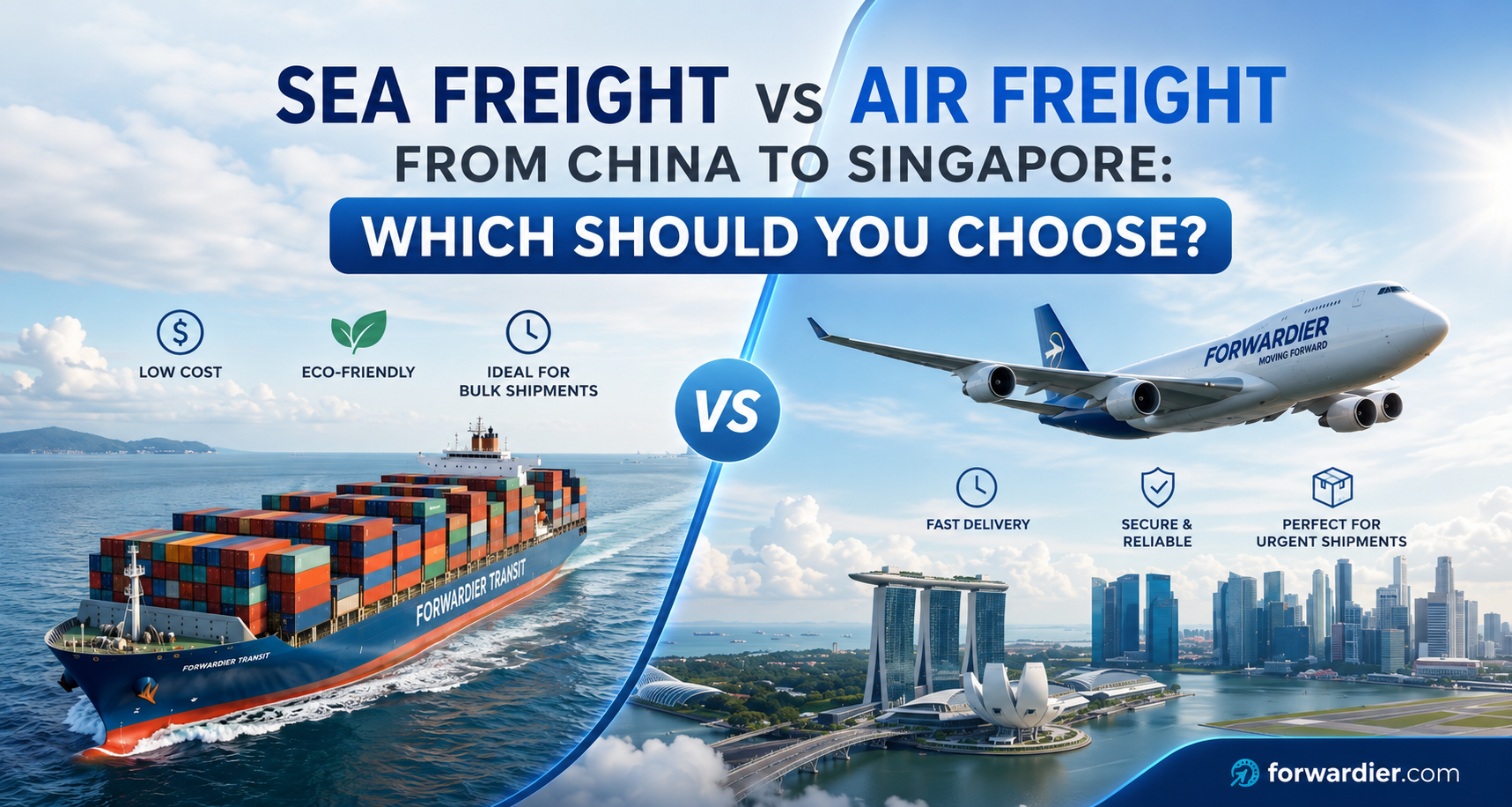
Sea freight is cheaper per kilogram but takes 2–3 weeks. Air freight is faster (4–6 working days) but costs nearly THRICE as much per kilogram. The right choice depends on your cargo size, timeline, and budget. If you haven’t read our sea freight vs. air freight comparison guide yet, that’s a good starting point.
Freight isn’t always priced on actual weight alone. Carriers use whichever is higher: your cargo’s actual weight, or its volumetric weight — a calculated figure that accounts for the physical space your cargo occupies. A large, light item like a sofa cushion or a hollow lamp base takes up significant cargo space relative to its weight, so volumetric weight pricing ensures fair cost allocation.
The volumetric weight formula differs slightly between sea and air freight. We’ll walk through both below.
Forwardier’s rates include door-to-door delivery to one Singapore address. Some providers quote port-to-port or warehouse-to-door rates that exclude local delivery — always confirm what’s included before comparing.
Import permit assistance, wooden crating for fragile items, and manpower for difficult last-mile deliveries (such as carrying heavy goods up HDB staircases) may add to the base freight cost. These are optional and priced transparently — we’ll cover them below.
Sea freight is priced using one of two methods depending on your cargo type. Both include door-to-door delivery to one Singapore address.
Shipment Type | Pricing Basis | Rate |
Small parcels (compact) | Weight-based (actual or volumetric) | From $8.00 SGD for first 2 kg |
Large / bulky cargo | Volume-based (CBM) | From $30.00 SGD for first 0.10 CBM |
Import permit (if required) | Per shipment | From $35.00 SGD |
Weight-based sea freight applies to compact, dense cargo. You pay based on your chargeable weight — actual weight or volumetric weight, whichever is higher.
Sea freight volumetric weight formula: Length (cm) × Width (cm) × Height (cm) / 5000
Example: a carton measuring 60cm × 50cm × 40cm has a volumetric weight of 0.6 × 0.5 × 0.4 / 5,000 = 24 kg. If the actual weight is 30 kg, you’d be charged based on 30 kg.
CBM (cubic metre) pricing applies to larger or bulkier cargo where volume is the primary cost driver. Your total shipment volume is measured in cubic metres:
CBM formula: Length (m) × Width (m) × Height (m)
Example: a pallet measuring 1.0m × 1.2m × 1.5m = 1.80 CBM. At $30 for first 0.10 CBM, this pallet costs approximately $230 SGD in sea freight.
If you’re shipping 10 cartons each measuring 0.6m × 0.4m × 0.3m, each carton is 0.072 CBM. Ten cartons = 0.72 CBM total. At $30 for first 0.10 CBM, the freight cost is approximately $115 SGD.
Not sure how to calculate your shipment? Send Forwardier your item list and dimensions on WhatsApp — we’ll work it out and quote you within minutes.
Air freight is priced on chargeable weight — actual weight or volumetric weight, whichever is higher. The volumetric formula for air freight uses a different divisor than sea freight, reflecting the higher premium on space in aircraft cargo holds.
Shipment type | Pricing basis | Rate |
All cargo | Chargeable weight (actual or volumetric) | First 1kg $15.00 SGD Next 1kg at $7.00 SGD |
Import permit (if required) | Per shipment | From $55.00 SGD |
Air freight volumetric weight: Length (cm) × Width (cm) × Height (cm) ÷ 6,000
Example: a box measuring 50cm × 40cm × 30cm has a volumetric weight of 50 × 40 × 30 ÷ 6,000 = 10 kg. If the actual weight is 6 kg, you’d be charged for 10 kg at $70 SGD.
Why is the air freight volumetric divisor different from sea freight?
Aircraft have limited hold volume and every cubic centimetre costs more to operate than sea container space. The 6,000 divisor (universal across the air cargo industry) reflects this higher per-space cost. Sea freight uses a formula that multiplies by 1,000 instead, resulting in lower volumetric weights for the same cargo — one reason why bulky, light items are often significantly cheaper by sea.
Here are representative cost estimates based on Forwardier’s 2026 rates. All figures include door-to-door delivery to one Singapore address.
Scenario | Actual Weight | Volumetric Weight | Chargeable Weight | Freight Cost |
10 boxes clothing (compact, 60cm x 50cm x 40cm per carton) | 300 kg | 240 kg (0.80 CBM) | 0.80 CBM | ~$130 SGD |
1.8m Sofa (bulky, light) | 80 kg | 300 kg (2.00 CBM) | 1.80 CBM | ~$250 SGD |
3 marble tile samples | 5 kg | 4 kg | 5 kg | ~$45 SGD (air) |
Vanity set (2 units) | 230 kg | 180 kg (2 CBM) | 2.00 CBM | ~$260 SGD |
Note: the marble tile sample scenario above uses air freight pricing, as this is the recommended method for sending samples before a full sea freight order.
A Bidadari homeowner imported 5 CBM of marble floor tiles from Foshan, China, for their 4-room BTO flat. The full shipment including sea freight, import clearance, and delivery (with manpower to carry tiles up to the unit) came in approximately 20% cheaper than equivalent tiles from Singapore suppliers. Transit time was 15 days.
A couple importing customised bathroom vanity sets for their Hougang HDB resale flat saved approximately 40% versus Singapore showroom pricing, even after accounting for sea freight, wooden crate repacking (required after a Taobao warehouse rejection), and last-mile delivery. Transit time was 16 days.
These are real Forwardier projects — see the full case studies on our Projects page.
Both projects demonstrate that even with freight, customs, and last-mile delivery costs included, importing renovation materials from China to Singapore can deliver significant savings compared to local suppliers.
Not all shipping quotes are created equal. The base freight rate is only part of the story — the real landed cost includes everything from customs clearance to local delivery. Here’s how Forwardier’s pricing compares to what you may encounter elsewhere:
Fee type | With Forwardier | Watch out for elsewhere |
Freight base rate | Stated upfront | Sometimes quoted without surcharges |
Customs clearance | Included | Sometimes charged separately |
Last-mile delivery | Door-to-door included | May be kerbside only |
Import permit assistance | From $35 (if needed) | May not be offered at all |
Fuel / handling surcharges | None | Common with larger operators |
Minimum charge | None | Some require 10kg minimum |
When comparing quotes from different freight forwarders, always ask: does this include Singapore customs clearance? Does it include last-mile delivery to my address? Are there any surcharges not shown in this quote?
Forwardier’s pricing principle
We provide a full cost breakdown before you commit to any shipment. The price you’re quoted is the price you pay — door-to-door, no surprises. If your goods require an import permit, we’ll tell you upfront and quote the permit assistance cost separately so you can make an informed decision. If you require changes to your delivery date or time-slot, so long as we can accommodate, no extra charges.
Some categories of goods entering Singapore require an import permit from Singapore Customs. This is common for certain food products, health supplements, regulated electronics, and cosmetics. Forwardier coordinates permit applications on your behalf:
Not sure if your goods need a permit? Share your item list with us before you purchase and we’ll advise. Identifying permit requirements before your goods are in transit is far cheaper than dealing with clearance holds after the fact.
For fragile, high-value, or awkwardly shaped items — bathroom vanities, mirrors, glass panels, marble pieces — wooden crating provides significantly better protection than standard cardboard during sea freight transit. If our China warehouse team identifies that your goods need upgraded packaging, we’ll advise you before the shipment departs and quote the crating cost separately.
Standard door-to-door delivery gets your goods to your building entrance or lift lobby. For heavy items being delivered to upper-floor HDB flats — marble tiles, vanity sets, large furniture — pallets need to be dismantled and goods carried up individually. Forwardier can arrange manpower for this on request. The cost depends on the weight, volume, and floor level involved.
As of 1 January 2024, all goods imported into Singapore are subject to GST at the current rate of 9%, regardless of the value of the goods. This change removed the previous low-value goods exemption that previously applied to imports under SGD 400.
GST is calculated on the customs value of your goods — roughly the purchase price plus freight cost. It’s collected by Singapore Customs at the point of clearance and is a cost to factor into your total landed price calculation.
How this affects your cost comparison with Singapore suppliers
When comparing the cost of importing from China versus buying from a Singapore supplier, remember: Singapore retail prices already include GST. Your China import will attract GST at the customs stage, which partially narrows the price gap. However, for most goods — especially building materials, furniture, and lifestyle products — the savings after GST are still substantial, as our project case studies demonstrate.
The most accurate way to understand what your specific shipment will cost is to request a quote directly. To give you the most precise figure, Forwardier needs:
You don’t need all of this to start a conversation. Many customers simply send us a Taobao cart link or a photo of the product listing — we’ll work out the dimensions and weight from there and get back to you with a quote.
No. Forwardier ships from 1kg with no minimum order quantity. Whether you’re sending one Taobao package or three pallets of commercial stock, we apply the same transparent pricing structure.
Yes — and we recommend it for most shipments. When you send us your cargo details, we’ll provide pricing for both options so you can make an informed decision based on your timeline and budget. There’s no obligation to proceed after receiving the quote.
A simple rule: if your cargo is over 5kg or bulky enough that volumetric weight exceeds actual weight significantly, sea freight is almost always cheaper. For compact, light items under 5kg where timing is flexible, compare both rates — the difference may be smaller than you expect. When in doubt, send us the details and we’ll calculate both.
Standard pricing covers most cargo. For extremely heavy individual items (single pieces over 500kg) or unusual dimensions that require special handling, we’ll advise on any additional costs when you request your quote. There are no surprise fees on delivery, so long as your items can fit inside the lift to access your unit, we will be able to deliver the items right to your unit.
Port-to-port quotes cover ocean or air transit only — they don’t include pickup from your Chinese supplier or last-mile delivery to your Singapore address. Door-to-door quotes (what Forwardier provides) include both ends of the journey. Always confirm what’s included when comparing quotes, as a lower base rate that excludes delivery can end up more expensive overall.
The extension of GST to all imported goods (including low-value imports previously exempt) increased the total landed cost for buyers importing smaller-value items. For higher-value goods, the impact is proportionally smaller relative to the cost savings from China sourcing. We always recommend factoring 9% GST into your total cost calculation when comparing import pricing against Singapore retail.
Send Forwardier your cargo details on WhatsApp and we’ll get back to you with a transparent, all-in quote covering freight, customs clearance, and door-to-door delivery to your Singapore address. Most quotes are turned around within minutes during business hours.
No minimum order. No commitment required. Just a clear price before you decide.
WhatsApp: +65 9736 6507
Operating hours: Monday to Saturday, 9:00am – 6:00pm
Or visit our Sea Freight and Air Freight service pages for detailed pricing information and transit time estimates.

Whether you need China-to-Singapore shipping, flexible warehouse storage, or distribution services, Forwardier can support your needs and business operations.
Nicklaus Neo is the founder of Forwardier, a Singapore-based freight forwarding company he started in 2021 after years of experience importing goods from China. Forwardier began under AJS Materials Trading before growing into a dedicated logistics provider serving eCommerce sellers, home-based businesses, and commercial importers shipping from China to Singapore.
3018 Ubi Rd 1, #03-117, Singapore 408710
Mon to Sat: 0900 - 1800hrs