Published August 11, 2026 · Last updated August 29, 2026
Taobao is one of the most cost-effective places in the world to source goods. Millions of Singaporeans use it every year — from individual shoppers buying furniture and lifestyle items to home-based sellers importing stock and SMEs sourcing commercial goods. But the process of getting purchases from China to Singapore comes with enough hidden pitfalls that even experienced importers occasionally get caught out.
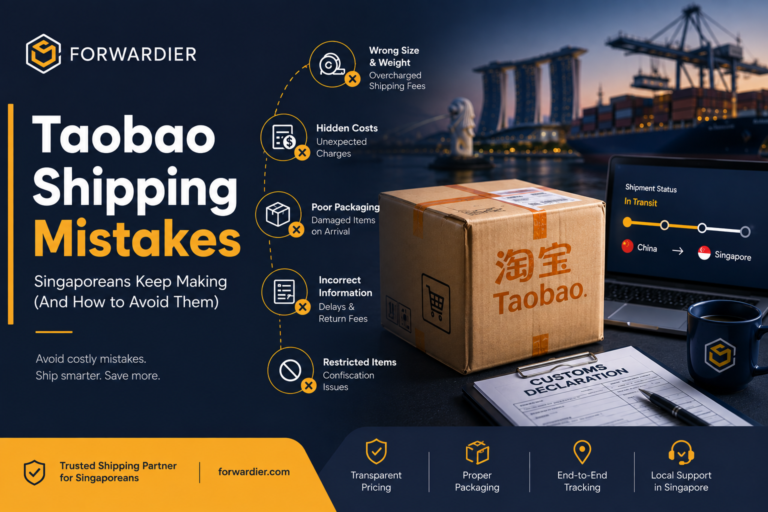
This guide covers the five most common and costly mistakes people make when shipping from Taobao to Singapore — based on real cases handled by Forwardier’s freight forwarding team. Each section explains what the mistake is, what actually goes wrong, and the exact steps to avoid it.
If you’re planning a Taobao shipment, reading this first could save you significant time, money, and stress.
# | Mistake | What goes wrong | How to avoid it |
1 | Using Taobao direct shipping for large or bulky items | Items rejected at the warehouse — left stranded in China | Use a freight forwarder’s China warehouse address instead |
2 | Not checking volumetric weight before ordering | Shipping cost is much higher than expected at checkout | Calculate volumetric weight before you buy |
3 | Skipping ordering samples for quality checking and visualisation | Receive goods that don’t match the design — entire batch unusable | Air freight samples first, sea freight the full order after |
4 | Not asking about import permit requirements | Shipment held at Singapore Customs — delays and extra costs | Check permit requirements before you purchase |
5 | Choosing on price alone without checking what’s included | Hidden fees added after — total cost higher than quoted | Always confirm door-to-door, customs, import tax and consolidation fees |
When placing an order on Taobao, the default shipping option is Taobao’s built-in direct shipping to Singapore. For most small, lightweight purchases — clothing, accessories, small electronics, books — this works fine. The problem starts when buyers use the same method for larger or heavier items.
Taobao’s direct shipping service imposes strict size and weight limits on parcels it accepts for international delivery. These limits are not prominently advertised during the checkout process. As a result, buyers complete their purchase, the seller ships the item to Taobao’s third-party logistics partner in China — and the parcel is rejected at the warehouse because it exceeds the size or weight threshold.
At this point, the item is stranded in a Chinese warehouse. The buyer is responsible for arranging an alternative shipping method, which often involves multiple redirections between warehouses before the goods finally reach a freight forwarder who can actually ship them. Each redirection adds time, handling risk, and cost.
Forwardier encountered exactly this scenario with a customer importing customised vanity sets for a Hougang HDB flat. The items were rejected by Taobao’s logistics partner due to size restrictions, had to be redirected to our China warehouse through multiple handovers, and arrived with packaging damage that required full inspection and wooden crate repacking before they could be shipped to Singapore. Despite all the complications, the customer still saved approximately 40% versus buying the same vanity sets from a Singapore showroom — but the process was significantly more stressful than it needed to be.
Furniture (sofas, wardrobes, beds, tables), bathroom fittings and vanity sets, marble and ceramic tiles, large appliances, heavy machinery parts, oversized décor items, and any single parcel exceeding approximately 30kg in actual weight or with dimensions exceeding 180cm on any single side. If your purchase falls into any of these categories, do not use Taobao direct shipping.
Before placing any Taobao order for a large or bulky item, contact a freight forwarder first. A good forwarder will:
Using a freight forwarder’s warehouse address instead of Taobao direct shipping bypasses the size and weight restrictions entirely. Your Taobao seller ships to the forwarder’s address — a standard domestic China delivery — and the forwarder handles the international leg.
Our warehouse is located in Guangzhou, Baiyun District (广州白云区). WhatsApp us before you order and we’ll confirm whether your items are suitable for our service. We will then give you the full warehouse address with your unique reference details and you may use it during your purchase.
Most buyers assume shipping cost is calculated purely on actual weight — how heavy the item is in kilograms. This is accurate for dense, compact items. But it’s not how freight is priced for larger or lighter goods.
Freight forwarders price shipments using chargeable weight — the higher of actual weight or volumetric weight. Volumetric weight accounts for the physical space a package occupies in a container or aircraft. A large, light item takes up significant cargo space even if it weighs relatively little, and forwarders price this accordingly.
For sea freight, the volumetric weight formula is: Length (cm) × Width (cm) × Height (cm) ÷ 5,000. For air freight, it is: Length (cm) × Width (cm) × Height (cm) ÷ 6,000.
A buyer who orders a large hollow item — a decorative lamp base, a folded mattress, a set of nested storage boxes — may be shocked to receive a freight quote that seems disproportionate to the item’s actual weight. The item might weigh 5kg but have a volumetric weight of 40kg, resulting in a charge four times higher than the buyer anticipated.
A 1.2m × 0.8m × 0.6m flat-pack wardrobe box has a sea freight volumetric weight of 120 × 80 × 60 ÷ 5,000 = 115 kg equivalent. If the actual weight is 45kg, sea freight is charged on 115 kg — not 45 kg. At $2.50/kg above the first 2kg, this is a significant difference from what a buyer expecting weight-only pricing would anticipate. Always calculate volumetric weight before you order.
Before placing your Taobao order, calculate volumetric weight using the packaging dimensions listed on the product page. Then compare it to the actual weight. If volumetric weight is significantly higher, factor the higher figure into your shipping cost estimate.
If you’re unsure how to calculate it, or the dimensions aren’t listed clearly on the product page, send the product link to your freight forwarder. At Forwardier, we calculate chargeable weight for customers on request — no commitment required, just send us the details on WhatsApp.
When importing tiles, marble, fabric, furniture, or decorative items, buyers often place a full order based entirely on product photos and seller descriptions. Product photography on Taobao can be excellent — well-lit, colour-corrected, and shot to show the item at its best. What it cannot fully convey is colour accuracy in different lighting, material texture and feel, print or veining consistency across multiple pieces, and quality variations between units.
A full sea freight shipment arrives in Singapore. The buyer opens the boxes and discovers the marble tiles are a different tone than they appeared on screen, the fabric colour clashes with the renovation palette they committed to, or the quality is inconsistent across pieces in the same batch. The entire order — multiple CBM of goods — is now either unusable or requires significant compromise.
Reordering means another 2–3 week sea freight cycle. Returning the goods to China is prohibitively expensive. And the renovation timeline has slipped.
Forwardier encountered this scenario with a Bidadari homeowner importing marble floor tiles from Foshan. Before committing to a 5 CBM sea freight order, they air-freighted a sample set first. The sample arrived in approximately five days, they evaluated the colour and finish in person in the actual flat under real lighting conditions, confirmed their selection, and then placed the full sea freight order with confidence. The total project — samples plus full shipment — came in approximately 40% cheaper than equivalent Singapore-sourced tiles, and the renovation proceeded exactly as planned.
For any purchase where colour accuracy, material quality, or physical finish matters, request samples before committing to a full order. The correct process:
Floor and wall tiles, marble and stone, fabric and textiles, wallpaper and vinyl flooring, paint or colour-matched items, wooden furniture where grain and finish vary, ceramics and tableware where glaze consistency matters, and any item where you are buying multiple units that need to match each other.
Most Taobao buyers assume that once their goods have been shipped and cleared China customs, they’ll arrive in Singapore without issue. For the majority of everyday consumer goods — clothing, household items, general electronics, furniture — this is true. But for certain categories of goods, Singapore Customs requires an import permit before the goods can enter the country. Many buyers only discover this requirement after their shipment is already in transit.
A shipment arrives at Singapore port and is held at customs clearance. The importer is notified that an import permit is required. They then need to apply for the permit — a process that takes time and, if not done correctly, can result in goods being held for extended periods or, in serious cases, seized.
Beyond the delay, applying for a permit after goods have arrived in Singapore is more stressful and often more expensive than arranging it in advance. Storage charges accrue at the port while the application is processed. And if the buyer didn’t budget for permit costs, it’s an unexpected expense on top of freight.
Before purchasing any item that falls into a regulated category, check whether a Singapore import permit is required. The best approach:
Identifying permit requirements before purchase gives you time to arrange documentation without pressure. Discovering them after your goods are in transit puts you in a reactive position where every day of delay costs money.
Send your item list to Forwardier on WhatsApp before you order. We’ll advise on permit requirements based on what you’re importing. This is a free pre-purchase check — no commitment required.
When comparing freight forwarders, most buyers look at the headline rate per kilogram and choose the lowest number. This seems like rational comparison shopping. In practice, it frequently leads to a higher total cost than a provider who quoted a slightly higher base rate.
Freight quotes are not always comparable on face value. Some providers quote:
A buyer who receives a $6/kg quote from Provider A and an $8/kg quote from Provider B may assume Provider A is 25% cheaper. But if Provider A’s quote excludes customs clearance ($50), local delivery ($30), and a consolidation fee ($40), while Provider B’s $8/kg rate is fully door-to-door with no add-ons, Provider B ends up cheaper on a shipment over a certain weight threshold.
Always ask for an all-in, door-to-door quote before comparing providers. The correct comparison is total landed cost — the complete price for your goods to go from your supplier’s hands in China to your doorstep in Singapore, with no additional costs.
At Forwardier, every quote is door-to-door and all-inclusive. The price you receive covers pickup coordination (if applicable), consolidation, freight, customs clearance, and last-mile delivery in Singapore. There are no consolidation fees, no fuel surcharges, and no minimum order requirements. If your goods require an import permit, we’ll flag it upfront and quote the permit assistance cost separately so it’s transparent — not a surprise.
These are the questions Forwardier receives most often from first-time and repeat Taobao importers. They’re answered here to give you a complete reference before your next shipment.
Most consumer goods can be shipped from Taobao to Singapore without issue. Goods that are restricted, prohibited, or require import permits include: certain food and health products, wireless devices and chemicals. When in doubt, check with your freight forwarder before purchasing.
Sea freight is the cheapest shipping method for heavier or bulkier Taobao purchases. Forwardier’s sea freight rates start from $8 SGD per kg (weight-based) or $30 SGD per 0.10 CBM (volume-based), with door-to-door delivery included. Air freight from $15 SGD per kg is faster but costs more — best suited to lighter or urgent orders.
Sea freight from Forwardier’s China warehouse to your Singapore address takes approximately 2–3 weeks. Air freight takes 4–6 working days. These timelines include customs clearance and last-mile delivery.
If your items are rejected by Taobao’s direct shipping service due to size or weight restrictions, your goods will be held at the logistics partner’s warehouse in China. You’ll need to arrange alternative shipping — typically through a freight forwarder. Forwardier can redirect goods from rejected warehouses to our China facility, though this process involves additional handling and lead time. The best way to avoid this scenario is to use a freight forwarder’s warehouse address from the start.
Yes. As of 1 January 2024, all goods imported into Singapore are subject to GST at 9%, regardless of value. GST is calculated on the customs value of the goods. Factor 9% into your total landed cost comparison when evaluating whether China sourcing is cheaper than Singapore retail.
The best freight forwarder for Taobao shipping to Singapore is one that offers transparent all-in pricing, no minimum order quantity, direct WhatsApp communication, and door-to-door delivery. Forwardier specialises in China-to-Singapore freight forwarding with no MOQ, sea freight from $8 for first 2kg, air freight from $15 for first 1kg, and has been operating this route since 2021.
Yes. This is one of the most practical advantages of using a freight forwarder. Multiple sellers send their goods independently to the forwarder’s China warehouse. The forwarder consolidates all purchases into one outbound shipment to Singapore. You pay one freight charge on the combined weight and volume — far more cost-effective than multiple separate shipments.
Avoiding these five mistakes starts before you place your order. Contact Forwardier on WhatsApp before you buy — we’ll check whether your items are suitable for sea or air freight, flag any permit requirements, calculate your chargeable weight and quote you upfront, and provide our China warehouse address with your unique reference details.
No commitment required to get a quote. Most enquiries are answered within the hour during business hours.
WhatsApp: +65 9736 6507
Operating hours: Monday to Saturday, 9:00am – 6:00pm
Or browse our shipping guides for more information on sea freight, air freight, LCL shipping, and warehousing in Singapore.

Whether you need China-to-Singapore shipping, flexible warehouse storage, or distribution services, Forwardier can support your needs and business operations.
Nicklaus Neo is the founder of Forwardier, a Singapore-based freight forwarding company he started in 2021 after years of experience importing goods from China. Forwardier began under AJS Materials Trading before growing into a dedicated logistics provider serving eCommerce sellers, home-based businesses, and commercial importers shipping from China to Singapore.
3018 Ubi Rd 1, #03-117, Singapore 408710
Mon to Sat: 0900 - 1800hrs