Published July 22, 2026 · Last updated August 29, 2026
If you’ve been researching freight forwarding options for shipping goods from China to Singapore, you’ve almost certainly come across the term LCL. It appears in freight quotes, shipping platform descriptions, and logistics guides — often without a clear explanation of what it actually means or whether it applies to your situation.
This guide explains LCL shipping in plain English: what it is, how it differs from FCL, how costs are calculated, and whether it’s the right option for your shipment. No jargon, no unnecessary complexity — just the information you need to make an informed decision.
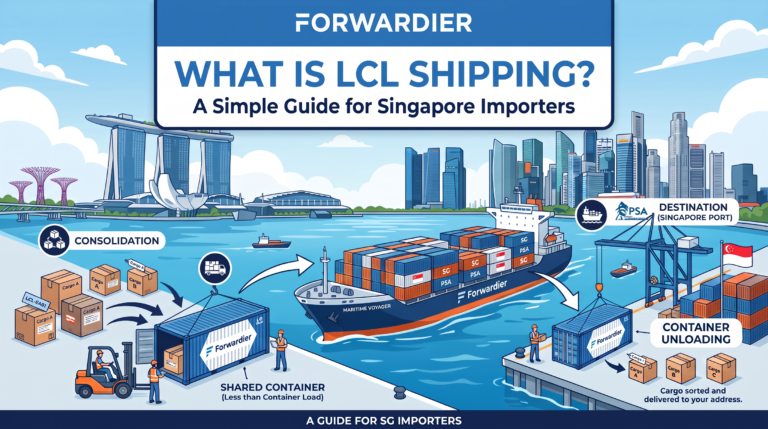
LCL stands for Less than Container Load. It refers to a sea freight arrangement where your cargo does not fill an entire shipping container — so your goods are consolidated with shipments from other importers to fill the same container.
Think of it like a shared taxi versus a private hire car. With LCL, you share the container space and only pay for the portion you use. With FCL (Full Container Load), you rent the entire container regardless of how much space your goods actually occupy.
The key benefit of LCL in one sentence
LCL lets small and medium-sized importers access sea freight rates — the most cost-effective shipping method for heavy or bulky cargo — without needing to fill an entire container. For most Taobao buyers, home-based sellers, and Singapore SMEs importing from China, LCL is the standard sea freight option.
Understanding the difference between LCL and FCL helps you understand which applies to your shipment — and why most individual importers and small businesses use LCL by default.
LCL (Less than Container Load) | FCL (Full Container Load) | |
What it means | Your cargo shares a container with other shipments | You rent the entire container exclusively |
Best for | Small to medium shipments (under 15 CBM) | Large shipments (40+ CBM) |
Cost structure | Pay only for the space you use | Fixed container rate regardless of fill |
Lead time | Slightly longer — consolidation adds time | Faster departure once container is booked |
Minimum volume | None — from 1 kg | Full container (20ft or 40ft) |
Risk | Goods share container — proper packaging is important | No contact with other cargo |
Who uses it | Individuals, SMEs, e-commerce sellers, Taobao importers | Manufacturers, large-volume commercial importers |
For context: a standard 20-foot shipping container holds approximately 25–28 CBM of cargo. A 40-foot container holds approximately 55–60 CBM. Most individual importers and small businesses shipping from China to Singapore are moving volumes well below 15 CBM — which puts them firmly in LCL territory.
When does FCL start making sense?
Once your regular shipment volumes consistently exceed 40 CBM per consignment, FCL becomes worth comparing. At that volume, the fixed container rate often works out cheaper than LCL per CBM — and you eliminate the consolidation step, which can save several days in lead time. If your business is growing toward this volume, ask Forwardier for an FCL comparison quote alongside your LCL pricing.
Once you’ve placed your order with a Taobao seller or Chinese supplier, you provide them with your freight forwarder’s China warehouse address. The seller ships the goods to that address rather than directly to Singapore.
When your goods arrive at the forwarder’s China warehouse, they’re received, counted, and checked against your packing list. Any packaging issues are flagged at this stage — before the goods leave China — which is the most practical point to address them. Forwardier inspects all incoming cargo and contacts customers if we notice anything that warrants attention.
Your cargo is combined with other Singapore-bound shipments from different importers into a single container. Each importer’s goods are clearly labelled and separated within the container. The consolidation process is managed by the freight forwarder — you don’t need to coordinate with other importers or be involved in the loading process.
The container is sealed and makes its way to port for customs inspections before loaded onto a vessel bound for Singapore. The sea transit between China and Singapore takes approximately 3–6 days depending on the origin port. Forwardier dispatches sea freight shipments daily, Monday to Friday.
When the container arrives at Singapore port, customs clearance is processed and the container gets delivered to our warehouse — all importer’s goods are retrieved, sorted and prepared for last-mile delivery. All deliveries are fulfilled within three working days.
Your goods are delivered to your specified Singapore address. Forwardier’s standard LCL sea freight service includes door-to-door delivery.
Stage | What happens | Your role |
1 | Goods are sent out by your suppliers | Provide suppliers the warehouse address, and forward the packing list to your forwarder. |
2 | Goods received at forwarder’s China warehouse and inspected | None — forwarder handles this |
3 | Cargo consolidated with other Singapore-bound shipments | None — forwarder handles this |
4 | Container loaded and vessel departs for Singapore | None — receive departure notification |
5 | Vessel arrives at Singapore port | None — receive arrival notification |
6 | Customs clearance and container un-stuffing | None — forwarder handles this |
7 | Last-mile delivery to your Singapore address | Receive your goods |
LCL sea freight from China to Singapore is priced using whichever is greater: actual weight or volumetric weight. This is the same chargeable weight principle used across freight forwarding, applied here to the portion of container space your cargo occupies.
Actual or volumetric weight, whichever is higher
First 2kg at $8.00 SGD
Next 1kg at $2.20 SGD
Applies to compact, relatively dense cargo where weight is the primary cost driver. Sea freight volumetric weight formula: Length (cm) × Width (cm) × Height (cm) / 5,000.
Example: a carton measuring 0.5m × 0.4m × 0.3m has a volumetric weight of 12 kg. If actual weight is 45 kg, chargeable weight is 45 kg. Cost = $102.60 SGD.
First 0.10 CBM: $30.00 SGD
Applies to larger or bulkier cargo where volume is the primary cost driver. CBM = Length (m) × Width (m) × Height (m).
Example: a pallet of goods measuring 1.0m × 0.8m × 1.2m = 0.96 CBM. At $30 for first 0.10 CBM, cost = $130 SGD.
Forwardier calculates both figures for every shipment and charges according to whichever is most cost-effective for our clients (kg or CBM). For most Taobao orders and consumer goods, weight-based pricing applies. For furniture, flooring, home décor items, and other bulky goods, CBM pricing is typically used. Send us your dimensions and weight and we’ll tell you exactly which applies and what your quote will look like.
Shipment | Volume (CBM) | Weight (kg) | Est. LCL cost (SGD) |
10 cartons of clothing | 0.72 CBM | 140 kg | ~$130 |
0.07 CBM | 15 kg | ~$30 | |
2.0 CBM | 185 kg | ~$260 | |
Furniture set (sofa + 2 chairs) | 3.5 CBM | 220 kg | ~$455 |
Commercial stock (mixed SKUs) | 8.0 CBM | 1800 kg | ~$920 |
All figures are estimates based on Forwardier’s 2026 rates and include door-to-door delivery to one Singapore address.
LCL sea freight from China to Singapore typically takes 2.5 to 3 weeks from when your goods arrive at our China warehouse to delivery at your Singapore door. Here’s how that time breaks down:
Total lead-time: typically 12–21 days from China warehouse to your Singapore address, depending on port efficiency and customs clearance speed. We quote 2.5–3 weeks to account for variability.
LCL is slightly slower than FCL — here’s why
Because LCL shipments need to wait for enough cargo to consolidate into a full container, there’s occasionally a brief holding period at the China warehouse before departure. Forwardier manages high-frequency consolidation lanes that minimise this wait — most shipments are loaded into a shipping container and depart within 2–3 days of arriving at our warehouse. If your shipment is time-sensitive, let us know and we’ll advise on the next departure.
LCL is the most accessible form of sea freight — it removes the volume barrier that would otherwise make container shipping impractical for smaller importers. Here’s who typically uses it:
Ordering furniture, renovation materials, or a large personal haul from Taobao? LCL sea freight is the most cost-effective way to move bulky or heavy goods from China to Singapore — significantly cheaper than Taobao’s direct shipping for larger orders, and dramatically cheaper than air freight for heavy items.
Businesses importing stock from Chinese suppliers — clothing, lifestyle goods, electronics accessories, kitchenware — use LCL regularly to move inventory from their supplier’s warehouse to Singapore. Regular LCL shipments every 4–6 weeks allow businesses to maintain stock levels without tying up capital in large FCL orders they can’t sustain.
Shopee, Lazada, TikTok Shop, and Carousell sellers sourcing products from China use LCL to replenish inventory on a predictable schedule. The key advantage over air freight: cost savings on heavier or bulkier products that would be expensive to fly, while maintaining acceptable lead times when planned into an ordering cycle.
Companies importing components, raw materials, equipment, or consumer goods from China in quantities below FCL threshold use LCL as their standard shipping method. As volumes grow, Forwardier can help assess when FCL becomes more cost-effective.
Homeowners and contractors importing tiles, flooring, furniture, lighting fixtures, and bathroom fittings from Chinese manufacturing hubs like Foshan, Zhongshan, and Guangzhou use LCL sea freight as the practical alternative to expensive Singapore retail. Our project case studies demonstrate the cost savings achievable — 20% to 40% cheaper than local sourcing even after freight, customs, and delivery.
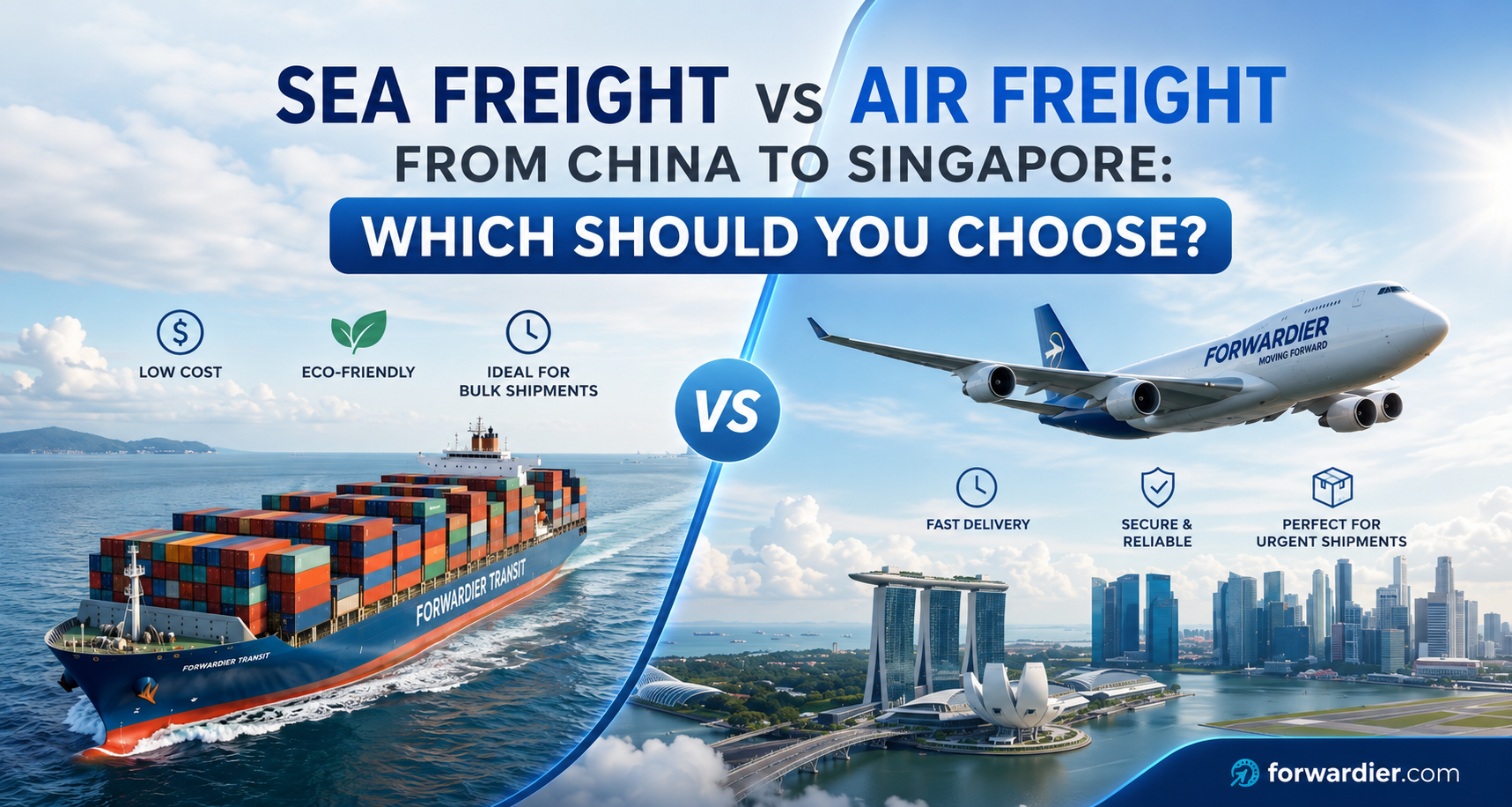
For many Singapore importers, the practical choice isn’t LCL vs FCL — it’s LCL sea freight vs air freight. Here’s a quick decision framework:
For a full comparison of sea freight versus air freight pricing, lead times, and use cases, see our detailed guide: Sea Freight vs Air Freight from China to Singapore.
Because LCL cargo shares a container with other shipments, proper packaging is important — both to protect your goods and to ensure they don’t damage other cargo in the container. Here are the key packaging principles:
Forwardier inspects all goods at our China warehouse
When your goods arrive at our China warehouse, our team checks for visible packaging damage before the shipment leaves China. If we identify packaging that’s insufficient for sea transit — particularly for fragile items — we’ll contact you and recommend upgrading the packaging before consolidation. Catching this in China is far better than discovering damage in Singapore.
No. Forwardier accepts LCL shipments from 1kg with no minimum volume requirement. Whether you’re shipping a single carton or 10 pallets, LCL pricing applies to the space and weight your cargo actually uses.
Yes. Forwardier provides WhatsApp updates at key milestones — when your goods arrive at our China warehouse, when the vessel departs, when it arrives in Singapore, and when your goods are out for delivery. If you need a status update at any point, message us directly and we’ll respond promptly.
Occasional delays occur due to port congestion, vessel schedule changes, or customs clearance queues. When delays arise, Forwardier proactively notifies you and provides a revised delivery estimate. We don’t wait for customers to chase us for updates.
Standard freight forwarding does not automatically include cargo insurance.
Yes — this is one of the most common uses of LCL with Forwardier. You provide multiple sellers with our China warehouse address, they each ship independently to us, and we consolidate all your purchases into a single outbound shipment to Singapore. You pay one freight charge on the combined weight and volume, rather than separate shipping fees for each seller.
Taobao’s direct shipping is a consumer-facing service with size and weight restrictions — it works well for small, light items but regularly rejects bulky or heavy goods. LCL sea freight via a freight forwarder handles cargo of virtually any size and weight, and is typically more cost-effective for larger orders. It also includes professional consolidation, customs coordination, and door-to-door delivery — services that Taobao direct shipping does not provide comprehensively.
Forwardier handles LCL sea freight from China to Singapore daily, Monday to Friday. Whether you’re shipping a single carton of Taobao purchases or multiple pallets of commercial stock, our team coordinates the full journey — supplier pickup, consolidation, customs clearance, and door-to-door delivery in Singapore.
Send us your cargo details on WhatsApp to get a transparent LCL quote within minutes. No minimum volume, no commitment required.
WhatsApp: +65 9736 6507
Operating hours: Monday to Saturday, 9:00am – 6:00pm
Or visit our Sea Freight service page for full pricing and lead time information.

Whether you need China-to-Singapore shipping, flexible warehouse storage, or distribution services, Forwardier can support your needs and business operations.
Nicklaus Neo is the founder of Forwardier, a Singapore-based freight forwarding company he started in 2021 after years of experience importing goods from China. Forwardier began under AJS Materials Trading before growing into a dedicated logistics provider serving eCommerce sellers, home-based businesses, and commercial importers shipping from China to Singapore.
3018 Ubi Rd 1, #03-117, Singapore 408710
Mon to Sat: 0900 - 1800hrs